
Mixture – Introduction
Matters can be classified into two types – Pure substances and Impure substances.
Pure substances – Pure substances are of two types – Elements and Compounds.
Impure substances – All mixture are considered as impure substances.
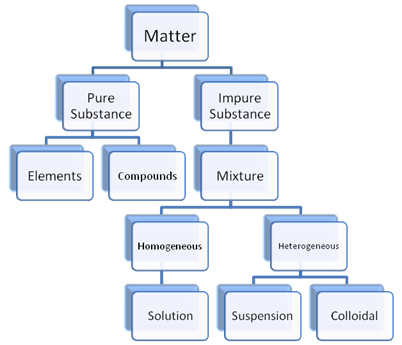
Most of the substances in our surroundings are not in their pure form and are called mixture. Substances which are made of two or more matters and which can be separated by physical methods are known as mixtures, such as mixture of salt and water, mixture of sugar and water, mixture of different gases, air, etc.
In a mixture, components do not combine chemically or through any chemical change. In a mixture, components do not lose their properties.
Mixtures are of two types on the basis of their composition – Homogeneous mixture and Heterogeneous mixture.
Homogeneous Mixture
Mixtures which have uniform composition throughout are called Homogeneous Mixture. For example – mixture of salt and water, mixture of sugar and water, air, lemonade, soda water, etc.
Mixture of salt in water is an example of homogeneous mixture. In this mixture, the boundary of salt and water cannot be differentiated. When a ray of light is passed through the mixture of salt and water, the path of light is not seen.
General Properties of Homogeneous Mixture:
- All solutions are the examples of homogeneous mixture.
- The particles of a homogeneous mixture are less the one nanometer.
- A homogenous mixture does not show Tyndall effect.
- The boundaries of particles cannot be differentiated.
- The constituent particles of homogenous mixture cannot be separated using centrifugation or decantation.
- Alloys are the examples of solution.
Heterogeneous Mixture
Mixtures which do not have uniform composition throughout are called Heterogeneous Mixture. For example – mixture of soil and sand, mixture of sulphur and iron fillings, mixture of oil and water etc. The boundaries of constituent particles of a homogeneous mixture can be identified easily; as a homogeneous mixture has two or more distinct phases.
General Properties of Heterogeneous Mixture:
- Most of the mixtures are heterogeneous except solutions and alloys.
- The constituent particles are present uniformly in a heterogeneous mixture.
- The components of a heterogeneous mixture can be identified easily.
- Generally, two or more phases are present in a heterogeneous mixture.
- Particles of a heterogeneous mixture are sized between one nanometer and one micrometer or more.
- Heterogeneous mixtures show Tyndall effect.
Types of Mixture
Mixture can be categorised in three types on the basis of their particles’ size. These are; solution, suspension and colloid.
Solution:
Mixture of two or more substances with one phase only, i.e. having no distinct boundary of constituent particles are called solution. For example, solution of sugar and water, solution of salt and water, lemonade, soft drinks, etc. Solution is a homogeneous mixture of two or more substances.
In a solution, components are mixed in such a way that they appear as only one phase. Seeing by naked eye, constituent particles of a solution cannot be identified because particles are mixed evenly throughout.
In a solution, there are two types of components – one is called solute and other is called solvent.
Solute – Substance which is present in smaller quantity in a mixture is called solute.
Solvent – Substance in a mixture which is present in larger quantity in a mixture is called solvent.
Example: In the solution of salt and water, salt is present in small quantity while water is present in larger quantity. Here salt is solute and water is solvent.
Solution of tincture iodine is made by dissolving iodine in alcohol. In this solution, iodine is solute and alcohol is solvent.
Air is mixture of many gases. Since air consists of only one phase, thus it is considered as solution. Air consists about 78% of nitrogen and 22% rest of other gases. Thus in the case of air, nitrogen can be called as solvent and rest other gases as solutes.
Solvent and solute can be solid, liquid or gas.
Types of solution
Solid – solid solution – Solution of two or more solids are generally known as solid-solid solution. For example – alloys. Alloy is a homogeneous mixture of two or more metals and non metals or two metals or two non-metals. The components of an alloy cannot be separated by physical methods, their boundaries are not distinct and they can have variable compositions, thus alloy is considered as solution.
Solid – Liquid solution – Solution of solid and liquid is called solid-liquid solution. For example – solution of salt and water.
Liquid – liquid solution – Solution of two miscible liquids are called liquid-liquid solution, such as solution of water and acetic acid. The solution of acetic acid in water is known as vinegar.
Gas – liquid solution – Solution of gas into liquid is called gas-liquid solution. For example – Soft drink. In soft drink, carbon dioxide is usually dissolved in liquid, because of which a hiss sound comes while opening the cap of the bottle.
Gas-gas solution – Solution of two or more gas is called gas-gas solution. For example – air, which is the solution of many gases, such as hydrogen, oxygen, carbon dioxide, etc.
General Characteristics of Solution:
- Solutions are homogeneous mixture of two or more substances.
- Constituent particles of a solution are mixed evenly throughout.
- There is only one phase in a solution.
- Boundaries of constituent particles cannot be distinguished.
- The size of particles of solution is smaller than one nanometer.
- Solutions do not show Tyndall effect, because, small particles of solution do not scatter the ray of light.
- Solute cannot be separated by using filtration or decantation.
- Solutions are stable, since when left undisturbed the particles do not settle in bottom.
Saturated and Unsaturated Solutions
Saturated Solution: When a solution cannot dissolve more solute at a given temperature, the point is called saturation point of the solution and solution is called saturated solution. This means, no more solute can be dissolved in a saturated solution at a given temperature.
Unsaturated Solution: Solution in which more solution can dissolved at a given temperature, is called unsaturated solution.
Solubility: Solubility is the amount of solute in a saturated solution at a given temperature. In other words, maximum capacity to dissolve a solute in a solution at a given temperature is called solubility.
Different solvents can dissolve different amount of solute. This means different solvents have different solubility Solubility increases with increase in temperature.
Concentration: Concentration is the amount of solute present in a given amount of solvent or solution.

Thus, concentration is the ratio of amount of solute and amount of solvent.
Concentration can be expressed in mass percentage or volume percentage of a solution.
(a) Mass percentage of a solution

This means when concentration is expressed in mass percentage, it is called concentration by mass percentage.
(b) Volume percentage of a solution

This means when concentration is expressed in volume percentage, it is called concentration by volume percentage.
Separation of Components of Mixture
Centrifugation –
In the method of centrifugation, the centripetal and centrifugal forces are used to separate lighter and heavier components of mixture of two immiscible liquids. This process is used to separate very small solids particles from a liquid mixture.
Example – Milk is the mixture of fat, water, and other constituents. Using the method of centrifugation, most of the fat can be separated from milk. In milk, fat is suspended throughout the milk which is separated out using the method of centrifugation.
When milk is churned rapidly, water which is heavier than fat, migrates away from the centre of centrifuge while fat is forced towards the bottom, which is drained out.
Application of centrifugation –
- In pathological test of blood and urine.
- In separation of fat from milk.
- In washing machines to squeeze the water from wet clothes.
Decantation –
Decantation is used to separate the components from a mixture of two immiscible liquids, such as mixture of oil and water. In a mixture of two immiscible liquids, lighter one and heavier one form separate layer. The lighter one can be decanted after settling of mixture, carefully in other container.
In the process of decantation some of the heavier liquid also poured out with lighter one. Therefore, components from a mixture of two immiscible liquids; can be separated more easily and accurately using a separating funnel.
A separating funnel is usually made of glass with a stop cork with drain pipe at bottom. The heavier liquid which is settled at bottom is drained out from the mixture of two immiscible liquids by opening of stop cork from a separating funnel.
Sublimation
There are many substances which are converted into gas from solid when heated, and converted from gas to solid when cooled without converting into liquid. Such substances are known as sublime. For example – ammonium chloride, naphthalene balls, camphor, etc. Therefore, mixture of one sublime and other substance can be separated using the method of sublimation.
The mixture of ammonium chloride and common salt can be separated out using the process of sublimation. For this, the mixture is heated in a China dish. The China dish is covered by an inverted funnel. Cotton is used for plugging the opening of the funnel. After heating, ammonium chloride is converted into vapour and gets deposited over the inner surface of funnel; due to cooling. This leaves the common salt in China dish. Ammonium chloride can be taken out by scratching from the inner wall of funnel.
Chromatography –
Chromatography is a method of separation which works on the principle of travel speed of components of a mixture. This method is used for separating dyes and pigments from a mixture. Ink is the mixture of dyes of different colours.
There are many types of chromatography. The dyes from an ink can be separated using paper chromatography.
For this, a strip of filter paper is dipped in the ink. Particles of dye start rising on filter paper; along with water. Different dyes rise with different speed because of different types of solubility in water and go up to certain heights.
Application of chromatography –
- In the separation of colours from a dyes.
- In the separation of pigments from natural colours.
- In the separation of drugs from blood for pathological tests.
Distillation –
The process of distillation is used to separate two miscible liquids. The technique of distillation is based on the difference in boiling points of components of mixture of miscible liquids. Distillation is to separate the liquids which do not decompose even upto their boiling points and should boil at more than 250C.
In the process of distillation, the mixture is heated after keeping in a retort or distillation flask. The liquid which boils at lower temperature is vaporized at lower temperature. The vapour so obtained is passed through a tube and gets condensed in a separate container; leaving liquid with higher boiling point in the retort or distillation flask.
Distillation is used to separate the components of the mixture of two miscible liquids that boils without decomposition and have sufficient difference in their boiling points.
The process of distillation is used to purify many liquids, such as water.
Fractional Distillation
Fractional distillation is the process of separation of components of mixture into parts or fraction on the basis of fractional differences in their boiling points.
Fractional distillation is done when the difference in boiling points of the components of miscible liquids is less than 250C. In the process of fractional distillation, a fractional column is used along with retort or distillation flask.
Fractional column is a tube which contains glass beads, which facilitate surface for the vapour to cool and condense repeatedly.
Example – Ethanol and water are separated from their mixture using fractional distillation. The boiling point of water is 100⁰C while the boiling point of ethanol is 78.4⁰C. Since the difference of their boiling point is less than 25⁰C, thus they are separated using fractional distillation.
Some of the Applications of Fractional Distillation:
- In petroleum refineries, petrochemical and chemical plants, natural gas processing and cryogenic air separation plants.
- In oil refineries to separate crude oil into useful substances (or fractions).
- In the process of organic juice.
- In the separation of oxygen, liquid nitrogen and argon from air.
Separation of different gases from air –
Air comprises of nitrogen, oxygen, carbon dioxide and argon as major components. Since air is the cheapest source of these gases, thus these are extracted from air at large scale
After liquefaction of air by repeated compression and cooling; nitrogen, oxygen, carbon dioxide and argon are extracted using fractional distillation.
Liquid nitrogen has boiling point equal to – 190⁰C and thus turns into gas first and separated from air.
The boiling point of argon is – 186⁰C, therefore it is extracted after argon.
The boiling point of oxygen is – 183⁰C, thus it is collected after the extraction of argon.
Carbon dioxide turns into solid at a temperature of – 97⁰C, therefore, it is removed while air is put under liquefaction.
Use –
Nitrogen is used as fertilizers, oxygen is used in hospitals and argon is used in bulbs.
Physical and Chemical Changes
Physical Change: The change in which no new substance is formed is called a physical change. During a physical change, chemical properties do not change but physical properties do change.
Chemical Change: The change in which a new substance is formed is called a chemical change. During a chemical change, chemical properties change.
Pure Substances
Elements and Compounds are considered as pure substances.
Elements – Substances that is made of only one element are called elements, such as hydrogen, carbon, oxygen, silver, gold, etc.
Compounds – Substances that is made of one or more elements by chemical combination are called compounds, such as water, carbon dioxide, copper oxide, hydrochloric acid, etc.
A compound does not contain the properties of its constituent elements and shows quite different characteristics.
Exemplar Problems and answer (NCERT)
Multiple Choice (MCQs)
Questsion: 1. Which of the following statements are true for pure substances?
(i) Pure substances contain only one kind of particles
(ii) Pure substances may be compounds or mixtures
(iii) Pure substances have the same composition throughout
(iv) Pure substances can be exemplified by all elements other than nickel
(a) (i) and (ii)
(b) (i) and (iii)
(c) (iii) and (iv)
(d) (ii) and (iii)
Answer: (b) (i) and (iii)
Questsion: 2. Rusting of an article made up of iron is called
(a) corrosion and it is a physical as well as chemical change
(b) dissolution and it is a physical change
(c) corrosion and it is a chemical change
(d) dissolution and it is a chemical change
Answer: (c) Corrosion and it is a chemical change
Questsion: 3. A mixture of sulphur and carbon disulphide is
(a) heterogeneous and shows Tyndall effect
(b) homogeneous and shows Tyndall effect
(c) heterogeneous and does not show Tyndall effect
(d) homogeneous and does not show Tyndall effect
Answer:- (a) Heterogeneous and shows Tyndall effect
Questsion: 4. Tincture of iodine has antiseptic properties. This solution is made by dissolving
(a) iodine in potassium iodide
(b) iodine in vaseline
(c) iodine in water
(d) iodine in alcohol
Answer: (c) Iodine in water
Questsion: 5. Which of the following are homogeneous in nature?
(i) ice (ii) wood (iii) soil (iv) air
(a) (i) and (iii)
(b) (ii) and (iv)
(c) (i) and (iv)
(d) (iii) and (iv)
Answer: (c) (i) and (iv)
Questsion: 6. Which of the following are physical changes?
(i) Melting of iron metal
(ii) Rusting of iron
(iii) Bending of an iron rod
(iv) Drawing a wire of iron metal
(a) (i), (ii) and (iii)
(b) (i), (ii) and (iv)
(c) (i), (iii) and (iv)
(d) (ii), (iii) and (iv)
Answer: (c) (i), (iii) and (iv)
Questsion: 7. Which of the following are chemical changes?
(i) Decaying of wood
(ii) Burning of wood
(iii) Sawing of wood
(iv) Hammering of a nail into a piece of wood
(a) (i) and (ii)
(b) (ii) and (iii)
(c) (iii) and (iv)
(d) (i) and (iv)
Answer: (a) (i) and (ii)
Questsion: 8. Two substances, A and B were made to react to form a third substance, A2B according to the following reaction :-
2 A + B → A2 B
Which of the following statements concerning this reaction are incorrect?
(i) The product A 2 shows the properties of substances A and B
(ii) The product will always have a fixed composition
(iii) The product so formed cannot be classified as a compound
(iv) The product so formed is an element
(a) (i), (ii) and (iii),
(b) (ii), (iii) and (iv)
(c) (i), (iii) and (iv)
(d) (ii), (iii) and (iv)
Answer: (c) (i), (iii) and (iv)
Questsion: 9. Two chemical species X and Y combine together to form a product P which contains both X and Y X + Y → P
X and Y cannot be broken down into simpler substances by simple chemical reactions. Which of the following concerning the species X, Y and P are correct?
(i) P is a compound
(ii) X and Y are compounds
(iii) X and Y are elements
(iv) P has a fixed composition
(a) (i), (ii) and (iii),
(b) (i), (ii) and (iv)
(c) (ii), (iii) and (iv)
(d) (i), (iii) and (iv)
Answer: (d) (i), (iii) and (iv)
Exemplar Problems and answer (NCERT)
Short Answer Type
Question: 10. Suggest separation technique(s) one would need to employ to separate the following mixtures.
(a) Mercury and water
Answer: The technique of Filtration
(b) Potassium chloride and ammonium chloride
Answer: Sublimation
(c) Common salt, water and sand
Answer: Sedimentation, decantation, filtration and evaporation
(d) Kerosene oil, water and salt
Answer: First filtration using separating funnel then after, vapourisation.
Question: 11. Which of the tubes in Figure given here (a) and (b) will be more effective as a condenser in the distillation apparatus?
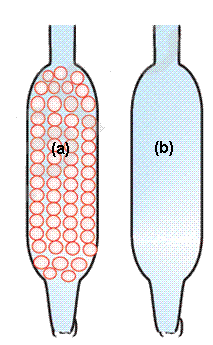
Answer: Figure (a) will be more effective, because of containing fractionating column.
Question: 12. Salt can be recovered from its solution by evaporation. Suggest some other technique for the same?
Answer: To separate salt from its solution crystallization can also be used.
Question: 13. The ‘sea-water’ can be classified as a homogeneous as well as heterogeneous mixture. Comment.
Answer:
Sea water is the mixture of many salts, water and other many impurities. Apart from these many gases are also dissolved in sea water. Because of salt and some other bigger size of impurities sea water is classified as heterogeneous mixture. Because of mixture of several gases in sea water it is also classified as homogeneous mixture.
Question: 14. While diluting a solution of salt in water, a student by mistake added acetone (boiling point 56°C). What technique can be employed to get back the acetone? Justify your choice.
Answer: Since, the boiling point of acetone is 560C and boiling point of water is 1000C, and for distillation the minimum difference in temperature should be 2500C. Thus by the process of distillation acetone can be separated.
Question: 15. What would you observe when
(a) a saturated solution of potassium chloride prepared at 60°C is allowed to cool to room temperature.
Answer: Since the solution is a saturated solution, and prepared at 600C which is above the room temperature, therefore, while it is allowed to cool at room temperature some of the potassium chloride will settle down at the bottom, because saturation decreases with decrease in temperature.
(b) an aqueous sugar solution is heated to dryness.
Answer: When an aquous solution of sugar is heated to dryness, the sugar will be left behind in the container after the vaporization of water. The sugar left in the container may be charred because of more heating.
(c) a mixture of iron filings and sulphur powder is heated strongly.
Answer: When a mixture of iron filling and sulphur power is heated strongly ferrous sulphide will be formed.
Question: 16. Explain why particles of a colloidal solution do not settle down when left undisturbed, while in the case of a suspension they do.
Answer: Particles in colloid is very small compare to that of the suspension. This makes the colloids more stable than suspension.
Because of the larger size of particles they settle down when suspension is left undisturbed. While in the case of colloid they do not settle as the particles are very small.
Question: 17. Smoke and fog both are aerosols. In what way are they different?
Answer:
Smoke – Smoke is mixture of gases and can goes to higher altitudes because of having more temperature.
Fog – Fog is mixture of liquid and gases. Fog is settled near the earth surface because of less temperature.
Question: 18. Classify the following as physical or chemical properties
(a) The composition of a sample of steel is: 98% iron, 1.5% carbon and 0.5% other elements.
Answer: This is the physical property. Since steel is the alloy and considered as mixture of more than one elements.
(b) Zinc dissolves in hydrochloric acid with the evolution of hydrogen gas.
Answer: This shows the reaction of zinc with hydrochloric acid, hence it is a chemical property.
(c) Metallic sodium is soft enough to be cut with a knife.
Answer: Since, it shows the softness of sodium, thus is a physical property.
(d) Most metal oxides form alkalis on interacting with water.
Answer: This property show the reaction of metal oxides with water, thus a chemical property.
Question: 19. The teacher instructed three students ‘A’, ‘B’ and ‘C’ respectively to prepare a 50% (mass by volume) solution of sodium hydroxide (NaOH). ‘A’ dissolved 50g of NaOH in 100 mL of water, ‘B’ dissolved 50g of NaOH in 100g of water while ‘C’ dissolved 50g of NaOH in water to make 100 mL of solution. Which one of them has made the desired solution and why?
Answer:
Concentration is the relative percentage of solute compared to the total volume of the solution and it is calculated by dividing mass by volume.
In the case of A, since 50g of NaOH has been dissolved in 100 mL of water, the total volume of solution became about 150 mL, thus concentration of NaOH would be less than 50%.
In the case of B, since 50g of NaOH has been dissolved in 100g of water, therefore, total volume of the solution would become 150 mL, consequently concentration of NaOH would again less than 50%.
In the case of C, 50g of NaOH has been dissolved in water and then volume of the solution made to 100mL, thus concentration of NaOH would become 50%.
Thus, C made the solution of NaOH having concentration equal to 50%.
Question: 20. Name the process associated with the following
(a) Dry ice is kept at room temperature and at one atmospheric pressure.
Answer: Since, when dry ice is left at room temperature, it turns into gas, thus this is the process of sublimation.
(b) A drop of ink placed on the surface of water contained in a glass spreads throughout the water.
Answer: When a drop of ink is placed on the surface of water, it spread over the water and finally mixed with water because of the motion of particles, hence this process is diffusion.
(c) A potassium permanganate crystal is in a beaker and water is poured into the beaker with stirring.
Answer: When potassium permanganate crystals are kept in beaker and water is poured and stirred, the particles of potassium permanganate would mix with water, because of motion of particles, stirring speed up the mixing process, hence this is the process of diffusion.
(d) A acetone bottle is left open and the bottle becomes empty.
Answer: Since acetone vaporizes at room temperature, when a acetone bottle is left open the acetone would vaporize and mix with air, thus this is the process of vaporization.
(e) Milk is churned to separate cream from it.
Answer: While milk is churned, the cream and milk is separated because of centrifugal force, thus this is the process of centrifugation.
(f) Settling of sand when a mixture of sand and water is left undisturbed for some time.
Answer: When mixture of sand and water is left undisturbed, the sand settle at the bottom of water, thus this is the process of sedimentation.
(g) Fine beam of light entering through a small hole in a dark room, illuminates the particles in its paths.
Answer: When fine beam of light entered through a small hole in dark room, because of collision of particles of air and dust, sunbeam illuminates the particles in its path and dust particles are appeared dancing, this happens because of the Tyndall effect.
Question: 21. You are given two samples of water labelled as ‘A’ and ‘B’. Sample ‘A’ boils at 100°C and sample ‘B’ boils at 102°C. Which sample of water will not freeze at 0°C? Comment.
Answer: Since impurities in water raise its boiling point, thus water in sample B is impure. Hence it will not freeze at 00C because of impurities since impAnswer: Since impurities in water raise its boiling point, thus water in sample B is impure. Hence it will not freeze at 00C because of impurities since impurities decreases the freezing point below the 00C, this is the cause that’s why sea water remain liquid below the 00C.
Exemplar Problems and answer (NCERT)
Short Answer Type – part – 2
Question: 22. What are the favourable qualities given to gold when it is alloyed with copper or silver for the purpose of making ornaments? ed with copper or silver for making of ornaments.
Answer: Since, Gold is a highly malleable metal so it is difficult to make the ornaments with pure gold, thus to make its rigidity desiring gold is alloyed with copper or silver for making of ornaments.
Question: 23. An element is sonorous and highly ductile. Under which category would you classify this element? What other characteristics do you expect the element to possess?
Answer: Since a metal is sonorous and ductile, thus if an element possesses these qualities this will be kept under the category of metals. The other qualities of metal are good conductor of heat and electricity, lustrous, malleability, etc.
Question: 24. Give an example each for the mixture having the following characteristics. Suggest a suitable method to separate the components of these mixtures
(a) A volatile and a non-volatile component.
Answer: The mixture of acetone and water. In this acetone is volatile and water is non-volatile. The mixture of water and acetone can be separated by the process of distillation.
(b) Two volatile components with appreciable difference in boiling points.
Answer: Mixture of acetone and ethanol. The boiling point of acetone is 560C and that of ethyl alcohol is 78.40C.
The mixture of acetone and ethanol can Answer: Mixture of acetone and ethanol. The boiling point of acetone is 560C and that of ethyl alcohol is 78.40C.
The mixture of acetone and ethanol can be separated using fractional distillation. er are two immiscible liquids, thus their mixture can be separated using separating funnel.
(d) One of the components changes directly from solid to gaseous state.
Answer: The mixture of salt and ammonium chloride. In this mixture ammonium chloride changes from solid to gaseous state directly.
The mixture of salt and ammonium chloride can be separated by the process of sublimation.
(e) Two or more coloured constituents soluble in some solvent.
Answer: The ink is the mixture of dyes of many colours.
The different dyes of ink can be separated using chromatography.
Question: 25. Fill in the blanks
(a) A colloid is a __________ mixture and its components can be separated by the technique known as _________.
Answer: heterogeneous, centrifugation
(b) Ice, water and water vapour look different and display different _________ properties but they are ___________ the same.
Answer: Physical, chemically
(c) A mixture of chloroform and water taken in a separating funnel is mixed and left undisturbed for some time. The upper layer in the separating funnel will be of________ and the lower layer will be that of ___________.
Answer: chloroform, water
(d) A mixture of two or more miscible liquids, for which the difference in the boiling points is less than 25 K can be separated by the process called____________.
Answer: Fractional distillation
(e) When light is passed through water containing a few drops of milk, it shows a bluish tinge. This is due to the _________ of light by milk and the phenomenon is called _________ . This indicates that milk is a ________ solution.
Answer: scattering, Tyndall Effect, colloidal
Question: 26. Sucrose (sugar) crystals obtained from sugarcane and beetroot are mixed together. Will it be a pure substance or a mixture? Give reasons for the same.
Answer: Pure substance, since it contains a single component, i.e. sucrose.
Question: 27. Give some examples of Tyndall effect observed in your surroundings?
Answer: Examples of Tyndall Effect:
Sunbeam coming from ventilation. The dust particles present in the way of beam looks luminous because of the scattering of light.
Milk in a glass appearing faint blue, since milk is a colloid and light passes through it scattered.
Sunbeam coming from behind the clouds looks luminous because of the scattering of light.
Question: 28. Can we separate alcohol dissolved in water by using a separating funnel? If yes, then describe the procedure. If not, explain.
Answer: The mixture of alcohol and water cannot be separated using a separating funnel, since these are not immiscible liquids.
The mixture of alcohol and water can be separated by the process of distillation.
Question: 29. On heating calcium carbonate gets converted into calcium oxide and carbon dioxide.
(a) Is this a physical or a chemical change?
Answer: The conversion of calcium carbonate into calcium oxide and carbon dioxide is a chemical change.
(b) Can you prepare one acidic and one basic solution by using the products formed in the above process? If so, write the chemical equation involved.
Answer: Yes one acidic and one basic solution can be formed by the calcium oxide and carbon dioxide, which are product formed in the above process.
Since metallic oxides are basic and non-metallic oxides are acidic in nature.
Calcium oxide is a metallic oxide. Hence by dissolving it in water a basic solution is formed because of the formation of calcium hydroxide. The reaction involvedCalcium oxide is a metallic oxide. Hence by dissolving it in water a basic solution is formed because of the formation of calcium hydroxide. The reaction involved in this can be written as follows:
CaO + H2O ⇌ Ca(OH)2
Carbon is a non metal hence carbon dioxide is acidic in nature. When it is dissolved in water an acidic solution is formed.
CO2+H2O⇌H2CO3
Question: 30. Non metals are usually poor conductors of heat and electricity. They are non-lustrous, non-sonorous, non-malleable and are coloured.
(a) Name a lustrous non-metal.
Answer: Graphite
(b) Name a non-metal which exists as a liquid at room temperature.
Answer: Bromine
(c) The allotropic form of a non-metal is a good conductor of electricity. Name the allotrope.
Answer: Graphite. Graphite is a good conductor of electricity. It is an allotropic form of carbon.
(d) Name a non-metal which is known to form the largest number of compounds.
Answer: Carbon is a non-metal. It is known to form the largest number of compounds.
(e) Name a non-metal other than carbon which shows allotropy.
Answer: Sulphur is a non-metal which shows allotropy. Disulphur and trisulphur are some of the allotropes of sulphur.
(f) Name a non-metal which is required for combustion.
Answer: Oxygen
Question: 31. Classify the substances given in Figure into elements and compounds
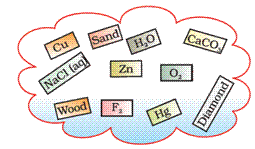
Answer:
Elements: Cu, Zn, O2, F2, Hg, Diamond
Compound: CaCO3, NaCl(aq), H2O,
Question: 32. Which of the following are not compounds?
(a) Chlorine gas
(b) Potassium chloride
(c) Iron
(d) Iron sulphide
(e) Aluminium
(f) Iodine
(g) Carbon
(h) Carbon monoxide
(i) Sulphur powder
Answer: Chlorine gas, iron, aluminium, iodine, carbon and sulphur powder are not compounds.
Long Answer Type Questions – part – 1
33. Fractional distillation is suitable for separation of miscible liquids with a boiling point difference of about 25 K or less. What part of fractional distillation apparatus makes it efficient and possess an advantage over a simple distillation process. Explain using a diagram.
Answer:
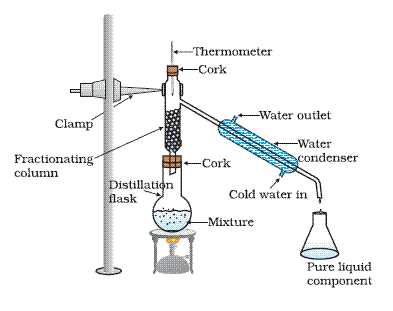
Ref: NCERT Book
Apparatus used for fractional distillation has a fractionating column. A simple fractionating column has glass beads in it which provide additional surface area because of which the vapours can spread and cool rapidly. Hence, fractionating column is used to provide the additional surface and to facilitate the cooling of vapour in many cycles.
34. (a) Under which category of mixtures will you classify alloys and why?
Answer:
When constituent particles of a combination of two or more element or compound retains their properties, then it is called mixture. In an alloy the constituent particles, hence alloys are classified as mixture. For example; steel is an alloy of carbon and iron.
(b) A solution is always a liquid. Comment.
Answer: Since, a solution is the homogeneous mixture of two or more substances, thus it is not necessary that a solution would always a liquid.
A solution can be in all the three states of matter. A solution is a homogeneous mixture and can be in all the three states of matter.
Example:
Solution of alcohol in water is a liquid.
Air is a solution of different gas.
Alloy is a solution which is in the form of solid.
(c) Can a solution be heterogeneous?
Answer: Solution is defined as the homogeneous mixture, hence a solution cannot be heterogeneous. But when a mixture becomes heterogeneous, it cannot be fall under the definition of solution.
35. Iron filings and sulphur were mixed together and divided into two parts, ‘A’ and ‘B’. Part ‘A’ was heated strongly while Part ‘B’ was not heated. Dilute hydrochloric acid was added to both the Parts and evolution of gas was seen in both the cases. How will you identify the gases evolved?
Answer:
Hydrogen gas is released, when dilute hydrochloric acid is added to part ‘A’. Hydrogen gas can be tested by brining a burning matchstick or candle near it. When a burning matchstick is placed near the hydrogen gas, it burns with a pop sound, which is a test for hydrogen gas.
Hydrogen sulphide gas released when dilute hydrochloric acid was added to part ‘B’. Hydrgoen sulphide gas smells like a rotten egg, hence it could be confirmed by its smell.
36. A child wanted to separate the mixture of dyes constituting a sample of in36. A child wanted to separate the mixture of dyes constituting a sample of ink. He marked a line by the ink on the filter paper and placed the filter paper in a glass containing water as shown in Fig. The filter paper was removed when the water moved near the top of the filter paper.
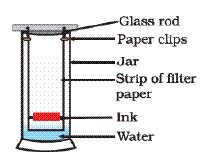
(i) What would you expect to see, if the ink contains three different coloured components?
Answer: Streaks of different colours can be seen on the filter paper.
(ii) Name the technique used by the child.
Answer: Chromatography
(iii) Suggest one more application of this technique.
Answer: Chromatography is used for separating pigments from colours, for the separation drugs from blood sample, etc.
Long Answer Type Questions – part – 2
37. A group of students took an old shoe box and covered it with a black paper from all sides. They fixed a source of light (a torch) at one end of the box by making a hole in it and made another hole on the other side to view the lig37. A group of students took an old shoe box and covered it with a black paper from all sides. They fixed a source of light (a torch) at one end of the box by making a hole in it and made another hole on the other side to view the light. They placed a milk sample contained in a beaker/tumbler in the box as shown in the Fig. They were amazed to see that milk taken in the tumbler was Fig.illuminated. They tried the same activity by taking a salt solution but found that light simply passed through it?
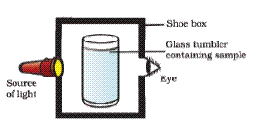
(a) Explain why the milk sample was illuminated. Name the phenomenon involved.
Answer: Since, milk is a colloid and when light scattered from the particles of colloids, it is illuminated, thus light was illuminated when passed through the milk. This is known as Tyndall Effect.
(b) Same results were not observed with a salt solution. Explain.
Answer: For scattering of light the size of particles should be large enough. Since the particles of solution are not enough to scattered the beam of light, hence same result were not observed.
(c) Can you suggest two more solutions which would show the same effect as shown by the milk solution?
Answer: Soap bubbles and fog are the colloids, hence same effect, i.e. scattering of light is shown by these. This is known as Tyndall effect.
38. Classify each of the following, as a physical or a chemical change. Give reasons.
(a) Drying of a shirt in the sun.
Answer: Drying of shirt in the sun is a Physical change. Since in this change no new substance is formed.
(b) Rising of hot air over a radiator.
Answer: Since, in rising of hot air over a radiator no new substance is formed, hence it is a Physical change.
(c) Burning of kerosene in a lantern.
Answer: While burning of kerosene in a lantern carbon dioxide, and water vapour is formed, hence it is a Chemical change.
(d) Change in the colour of black tea on adding lemon juice to it.
Answer: In this change a new substance is formed, hence it is a Chemical change.
(e) Churning of milk cream to get butter.
Answer: While churning of milk cream to get butter, no new substance is formed, hence it is a Physical change.
39. During an experiment the students were asked to prepare a 10% (Mass/Mass) solution of sugar in water. Ramesh dissolved 10g of sugar in 100g of water while Sarika prepared it by dissolving 10g of sugar in water to make 100g of the solution.
(a) Are the two solutions of the same concentration
Answer: No, the two solutions have different concentrations.
(b) Compare the mass % of the two solutions.
Answer:
We know;

For first solution:
Mass of solute = 10 gram
Mass of solution = 100 gram + 10 gram = 110 gram
Hence;

For second solution:
Mass of solute = 10 gram
Mass of solution = 100 gram
Hence;

Mass percent of first solution: Mass percent of second solution = 9.99: 10
40. You are provided with a mixture containing sand, iron filings, ammonium chloride and sodium chloride. Describe the procedures you would use to separate these constituents from the mixture?
Answer: The given mixture can be separated using the following process.
Magnetic Separation: Using magnetic separation the iron fillings can be separated from the given mixture.
In this a magnet is hover just above the mixture, since iron is a magnetic substance it is attracted by magnet and stuck with it. By this first of all iron fillings are separated.
Sublimation: After the separation of iron fillings, ammonium chloride is separated by the process of sublimation.
Since, ammonium chloride is a sublimate and it turns into vapour directly without changing into liquid, thus when the mixture is sublimated, the ammonium chloride is deposited over the inner wall of funnel leaving the sodium chloride and sand in the watch glass. Ammonium chloride is separated by scratching from the inner wall of the funnel.
Filtration: Now the left mixture of sand and sodium chloride is put in water, after stirring the sodium chloride is dissolved in water. The solution is separated by the process of filtration. The sand left over the filter paper is separated out.
Vapourisation: By the process vaporization, the liquid so obtained is vapouried and crystals of ammonium chloride can be obtained.
Hence, by using the methods of magnetic separation, sublimation, filteration and vapourisation and crystallization the component of given mixture of sand, iron fillings, ammonium chloride and sodium chloride can be separated.
41. Arun has prepared 0.01% (by mass) solution of sodium chloride in water. Which of the following correctly represents the composition of the solutions?
(a) 1.00 g of NaCl + 100g of water
(b) 0.11g of NaCl + 100g of water
(c) 0.0l g of NaCl + 99.99g of water
(d) 0.10 g of NaCl + 99.90g of water
Answer: (c) 0.01 g of NaCl + 99.99 g of water
42. Calculate the mass of sodium sulphate required to prepare its 20% (mass percent) solution in 100g of water?
Answer: In a 20% solution containing 100 g water; the mass percentage of water = 100 – 20 = 80%
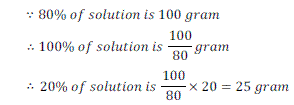
Hence; to prepare 20% (w/w) solution in 100 gram of water 25 gram of sodium sulphate is needed.
____________________________________________________
 CBSE AND ICSE SOLVER